Rock and Pop
ROCK 'N' ROLL
The youth culture following World War II produced a large teenage market, and from around 1955 a new dominant style developed: ROCK AND ROLL, which combined elements from white country-and-western music and black rhythm-and-blues. Rock 'n' roll used the 12 bar blues chord pattern from jazz, but now played faster with electric guitar and a lead singer. It appealed to teenagers because it was different, it was rebellious, and it was their own music.
In 1955 Little Richard exploded onto the scene with Tutti fruitti, screaming the words and pounding on the piano. Two other black 'pop' stars of Rock 'n' roll were Chuck Berry and "Fats" Domino, and two white stars were Elvis Presley and Buddy Holly. The most famous Rock 'n' roll group was Bill Haley and the Comets who created a sensation with the film Rock Around the Clock in 1955.
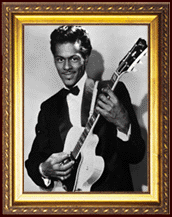

Chuck Berry "Fats" Domino Buddy Holly and the Crickets
Rock 'n' roll was heavily marketed to mass audiences, especially teenagers. England's contribution to Rock 'n' roll came towards the end of the 1950s with Cliff Richard and Tommy Steele.
ELVIS PRESLEY
Elvis Presley's first record, That's All Right Mama was released in 1954 and took America by storm. His unique singing, swivelling hips, guitar held low and arrogant sneer combined to create a spectacular stage performance. In 1956 he secured a contract with RCA and won international fame with a string of no.1 hits such as Heartbreak Hotel, Hound Dog, Love Me Tender, It's Now or Never, and Jailhouse Rock. By 1956 he had sold more than 20 million records. After two years military service, he returned in 1960 a changed man and performer. He now had a clean cut image and altered his style to suit an older audience. His music lost a lot of its rock 'n' roll bite and became slower, gentler and more ballad like. It's Now of Never, Return to Sender, Are you Lonesome Tonight and Wooden Heart were all no.1 hits in the UK.
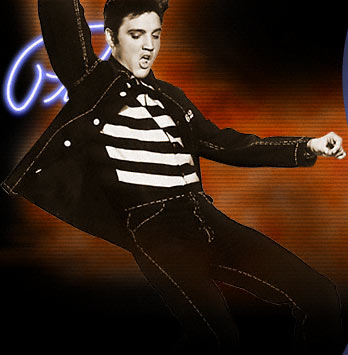
He starred in 27 Hollywood films during the 1960s, but his popularity started to decline due to competition from British groups such as the Beatles. His output decreased due to him growing less inclined to leave the comfort of his Graceland estate in Memphis. A live televised show was transmitted all over the world in 1973 and set a world-wide audience record. He died in 1977, at the age of 42, from a drug induced heart attack. By the time of his death he had sold over 600 million records. Since his death he has sold a further 100 million records. His singles have spent a total of 1149 weeks in the British charts, making him by far the most successful recording artist of all time.
1960s
Pop music belonged to Britain in the 1960s, and for the first time Britain led America in pop trends with the Beatles and the Rolling Stones.
THE BEATLES
The Beatles - Paul McCartney, John Lennon, George Harrison, and Ringo Starr - have been the most influential performing group in the history of pop music. Their music, hairstyle, dress, and lifestyle were imitated all over the world, resulting in a phenomenon known as Beatlemania.
The Beatles were formed in 1957 when John Lennon and Paul McCartney formed a group called the Quarrymen in Liverpool. By 1960 they had changed their name to the Beatles. They had grown up with the American rock 'n' roll of Chuck Berry, Little Richard, Buddy Holly and Elvis Presley. The Beatles played this music but Lennon and McCartney started writing their own material for the band. Their manager Brian Epstein signed them to EMI and in 1962 they released Love Me Do which reached no.17 in the charts. Their next single Please, Please Me went to no.1 and was followed by 17 other number one hits as well as many others in the top 20. By 1963 they had conquered the pop scene in Britain, Europe and America. By 1964, when the Beatles first toured the U.S., the main instruments of 1960s pop had emerged: electric lead guitar, rhythm guitar, and bass guitars; drums; and often piano or electric keyboard. This established a musical pattern in their line-up which was to be copied for years, marked the final split from the style of pop music whose connections went back to the Swing era, and heralded the 'media' influence on pop. The Beatles reacted against the fashions of Rock 'n' roll and the term Rock began to replace Rock 'n' roll. The Beatles stopped touring in 1966, because most of their most imaginative music was achieved in the recording studio and could not be duplicated live. The Beatles had 39 top 40 hits in the British Chart, including 18 no.1s. Every Beatles album went to no.1 resulting in 1160 weeks in the British album charts.
THE BEATLES' SGT. PEPPER'S LONELY HEARTS CLUB BAND (1967)
The Beatle's experimental style can be seen in the Sgt. Pepper's Lonely Hearts Club Band album of 1967. It was entirely different from anything which had gone before and was to change the entire face of pop music. The lyrics were often weird and shocking. Advanced technological tricks such as varying the speed of instruments and vocals, echoing sounds, and advanced multi-track recording all contributed to produce a revolutionary sound. Paul McCartney had conceived the idea of the Beatles taking on the role of a fake group, called Sgt. Pepper's Lonely Hearts Club Band. The Top Ten selling albums in the UK are -
1.SGT. PEPPER - THE BEATLES1967-4.25 MILLION
2.BAD - MICHAEL JACKSON1987-3.9 MILLION
3.STARS - SIMPLY RED1991-3.6 MILLION
4.BROTHERS IN ARMS - DIRE STRAITS1985-3.6 MILLION
5.(WHAT'S THE STORY) MORNING GLORY - OASIS1995-3.6 MILLION
6.GREATEST HITS VOLUME ONE - QUEEN1981-3.3 MILLION
7.THRILLER - MICHAEL JACKSON1982-3.3 MILLION
8.THE IMMACULATE COLLECTION - MADONNA1990-2.7 MILLION
9.THE VERY BEST OF ELTON JOHN - ELTON JOHN990-2.7 MILLION
10.BUT SERIOUSLY - PHIL COLLINS1989-2.4 MILLION
Sgt. Pepper was the first rock album to be presented as a unified song cycle. The cycle's thirteen songs are unified by the device of a music hall show in which the audience is entertained by a dazzling variety of acts. The opening two songs are addressed to the audience, and we hear the sounds of crowd noises, instruments being tried out, applause, and the brasses of Sgt. Pepper's band. This first song acts as an overture for the whole album.
The closing song of the first side - Being for the Benefit of Mr. Kite - tells the audience about an evening performance.
The inspiration for this song was a circus poster which John Lennon had bought from an antiques shop in 1967. The poster describes the acts at a performance taking place in 1843.
A song about a real person is Lovely Rita composed by Paul McCartney after getting a parking ticket outside his record company offices. The traffic warden who gave McCartney his parking ticket was called Meta Davis.
A more peculiar song which appears on the Magical Mystery Tour Album is I am the Walrus. The original inspiration for this song was a letter sent to John Lennon by a boy at his old school, Quarry Bank, telling how his English class were analysing the Beatles' lyrics, a fact that Lennon found hilarious as his old English teachers had dismissed him as a talentless disrupter. The words are based on the playground chant 'Yellow matter custard, green slop pie, All mixed together with a dead dog's eye'. He added to this a string of lyrics which in a meaningless fashion attack education, art, culture, law, and religion. The song was banned by the BBC for its use of the word 'knickers'.
Contributing to the record's musical continuity is the return of the opening Sgt. Pepper's Lonely Hearts Club Band as the second to last song, as well as the fact that there are no pauses between the first two songs and between the last three. Two of the LPs most original songs are Lucy in the Sky with Diamonds and A Day in the Life. Lucy in the Sky with Diamonds evokes a world of fantasy and daydream. It was a controversial song because some critics believed the title stood for LSD (i.e. Lucy, Sky, and Diamonds), LSD being an Hallucinatory drug. Apart from its introduction, the song is made up of three sections that are repeated: A, B, and C. Sections A and B are relatively soft with three beats per bar. In contrast, section C (the chorus) is loud, heavily accented and with four beats per bar.
The concluding song, A Day in the Life, uses electronic effects with an inventiveness ous stage acts appeared. Performers included the Byrds, The Who, Jimi Hendrix, and Simon and Garfunkel. There were also some experiments with harmony, form, and instrumentation (sitars and synthesisers), notably by the Beatles. By the end of 1969 flower power had withered and died.
JIMI HENDRIX
Jimi Hendrix was an American guitarist who, with his band the Jimi Hendrix Experience achieved chart success in the late 1960s. His 1967 song Purple Haze demonstrated explosive guitar work and unusual lyrics such as "Scuse me while I kiss the sky". Hendrix created all kinds of new and strange sounds from his guitar by using distortion, feedback and wah wah pedal. Part of his appeal was his wild and violent stage act which involved playing his Fender Stratocaster with his teeth and behind his back. On stage he usually used 9 amplifiers and 18 speakers. He often brought the show to a climax by setting light to his guitar. In 1969 the Jimi Hendrix Experience broke up and Hendrix continued as a soloist. In 1970 he performed before an audience of 250,000 at the Isle of White Festival. In September 1970, Hendrix died from an overdose of drugs. He was just 27.
Hendrix was one of the most creative and skilful performers in pop music. he opened up new opportunities for a generation of rock musicians, particularly in the fields of heavy metal and hard rock.
REGGAE
In the late 1960s, Reggae developed from Jamaican calypso and American rhythm and blues. It was also heavily influenced by the hymns of the Christian Revival Churches and the Rastafarian movement (Rastafarianism was a religious movement amongst the blacks in Jamaica). The influence of Rastafarianism can be seen in the lyrics of many reggae songs which often speak of 'Babylon'. 'Zion' and other religious subjects.
In reggae the emphasis is on the rhythm provided by the drums, guitar and keyboard. Only small snatches of melody are heard. The most famous reggae artist was Bob Marley. His music was particularly influenced by gospel songs. His lyrics often dealt with Rastafarianism and the need for political change. He also wrote haunting songs such as No Woman, No Cry. In 1981, at the height of his popularity and influence, Bob Marley was struck down by cancer. Since then reggae has continued to be part of the pop scene amongst both blacks and whites. Groups such as Aswad and UB40 continue to spread protest against youth unemployment and racial tension.
1970s
In 1970 Jimi Hendrix died, the Beatles broke up and Simon and Garfunkel went their separate ways. No one style dominated the 1970s.
BOB DYLAN
One performer who spanned the 1960s and 1970s was Bob Dylan. Dylan's early songs were accompanied by his own guitar and blues harmonica. Songs such as Blowin in the Wind became immensely popular and were adopted by many teenagers as anthems for peace, and against racial discrimination. Dylan's attraction was perhaps that his music was raw, natural and in complete contrast to the increasingly studio-created sounds of other major groups. As a performer, Dylan's voice was harsh and nasal and his acoustic guitar accompaniment very ordinary. However, as a songwriter he was outstanding. Dylan's work encouraged a whole generation to have confidence and speak out for themselves. His songs influenced other writers and performers including the Beatles and the Rolling Stones. Dylan's later material was backed by a rock band, and his efforts as a songwriter do not seem to have matched his earlier work.
The 1970s also saw the establishment of some hard rock styles such as Heavy Metal - Led Zepplin, Black Sabbath, etc.
HEAVY METAL
Heavy metal is a mainly British and American style of Rock consisting of very loud, distorted 'power chords' played on the electric guitar, high pitched guitar solos and a stomping drum beat. Vocals are often delivered in a screeching or barking style. The lyrics are often concerned with rebellion, sex, violence, death, and Satanism. Stage performances are often theatrical with flashing lights and explosions. The guitar heroes of the late 1960s such as Jimi Hendrix and Eric Clapton experimented with long experimental twisted guitar solos, heavy bass accompaniment and thunderous drumming.
In 1968 the first real heavy metal band, Led Zepplin, was formed. The 1970s saw the formation of other successful groups such as Black Sabbath, Deep Purple, ACDC and Iron Maiden. In the 1980s Thrash metal groups such as Metallica, Megadeth and Anthrax played a fast and furious style with aggressive lyrics screamed at the audience.
Some of the 1970s pop trends can be identified as -
1.'Glam' Rock, e.g. Sweet, Slade, Marc Bolan, Gary Glitter
2.'Ideal People', e.g. The Osmonds, The Jackson 5, The Monkees, Abba, The Carpenters
3.Solo Male Stars, e.g. David Bowie, Elton John, Rod Stewart, Bob Marley, Stevie Wonder
4.Solo Female Stars, e.g. Tammy Wynette, Dolly Parton, Olivia Newton-John, Suzi Quatro
and many more.
GLAM ROCK
Glam Rock was a fun version of basic rock 'n' roll. Performers wore outrageous outfits complete with platform boots and make up. Marc Bolan and T Rex had 12 Top 10 hits in 1972-73. Gary Glitter reflected the fun, comic side of glam rock, and between 1972-75 he turned out 11 top ten hits including three no.1s. Elton John was also an outrageous glam rock star, as was David Bowie, both of whose work has outlasted the glam rock era. The rise of Punk Rock in 1976 saw the end of the glam rock era. Those performers who survived, such as Elton John and David Bowie, did so by changing their image and style.
ABBA
This Swedish pop group were formed in 1972. They decided to perform their songs in English so they could sell their records to the much larger markets of Britain and America. Their nine years of fame produced nine no.1 singles and eight no.1 albums. From 1975 their song S.O.S was to be the first of eighteen consecutive top ten hits. Mama Mia, Fernando, Dancing Queen, Knowing Me, Knowing You, Money, Money, Money and Supertrouper achieved tremendous sales figures. By 1978 ABBA were earning £16 million a year. Statistically they are the second most successful group of all time after the Beatles.
Their success was due to well written and cleverly arranged songs with catchy melodies and bright rhythms, making a very commercial sound. The group disbanded in 1982, but still have chart success with re-released material such as the albums Abba Gold and More Abba Gold.
In the late 1970s, uncomplicated rhythmic disco music became popular for dancing. Three other branches of 1970s pop music deserve individual attention: Soul, Funk and Punk.
SOUL
Soul has its origins in Black American music from the end of the 1800s, and has been written and performed mainly by Afro-Americans The 'pop' form of soul emerged in the early 1960s as a mixture of the preaching style of gospel music and the more worldly themes of the blues. Soul is as much a style of presentation, of feel and of mood, as it tries to move an audience by communicating the strongly felt emotions of the performer. This often involved sobs, sighs, and high pitched shouts.
A pioneer of soul music was James Brown. He has achieved over 50 Top 40 hits in the USA and is still a major force in soul music. Tamla Motown and the Atlantic Record Company, with artists such as Diana Ross, the Supremes, Stevie Wonder, Aretha Franklin, Otis Redding, The Platters, and Roberta Flack, have produced traditional soul and a style of soul substantially watered down by the bright and simple melodies of mainstream pop.
During the 1980s soul influenced a number of singers such as George Michael, Annie Lennox and Phil Collins. In the 1990s, Lisa Stansfield has achieved success with a style very close to soul.
FUNK
Funk developed in the late 1960s more as a kind of dance music rather than something to be listened to. It mixes elements of early soul with white rock music to produce a fast and furious sound performed on stage with much energetic movement. The real creator of modern funk was James Brown. He developed a powerful stage act with incredible footwork. His 1965 hit Papas got a brand new bag shows the feverish side of funk.
Other funk performers include Sly and the Family Stone. During the 1970s, Stevie Wonder began to experiment with synthesisers and drum machines to produce an electronic version of funk. It was from these early beginnings that Prince and Michael Jackson developed the electro funk sounds of the 1980s. Michael Jackson's Thriller album achieved sales of 40 million world-wide. Electro funk has also influenced Bowie, Duran Duran and INXS.
PUNK
By the mid 1970s the rock stars of the 1960s such as the Beatles and the Rolling Stones were wealthy men in their 30s who had little to say to the new generation of teenagers facing unemployment and lack of money. Equally, the sugary lyrics of disco bands such as Abba did not appeal. From about 1976 the punk rock movement emerged to challenge these bands. Punk fashions of safety pins through the ear and nose, and mohican hair styles were intentionally outrageous. Punk music was similarly shocking. It was a raw amateurish style with negative and often obscene lyrics were shouted to tuneless melodies. These were usually drowned out by distorted instrumental backing with guitars sounding like chain saws.
This fairly short lived movement in pop history has left its mark on a good deal of 80s music. The Sex Pistols, formed in 1975, led the way and sought popularity by making themselves as unpopular as possible. The band members gave themselves names such as Johnny Rotten and Sid Vicious. They were sacked by their record company for swearing too much on a live television show. They signed up with Virgin records, but many shops refused to stock their records because of the obscene lyrics.
Nevertheless, they were popular with teenagers and had 11 hit singles in 3 years. Many performances were marked by extremes of costume and staging. Inevitably, Punk could only last a short time, and when the Sex Pistols split in 1978, the Punk movement was over. Punk groups such as The Damned, The Clash, The Jam, and the Stranglers survived by developing a more sophisticated style than their earlier punk days. By the 1980s its American version 'New Wave' lent a sufficiently respectable aim to the movement to allow it to continue.
NEW WAVE
New Wave developed out of Punk in the late 1970s. New Wave was gentler, more sophisticated and more commercial. Electronic drum machines created a simple, repetitive beat. Melodies were not strong and vocal were often high pitched, toneless and sounded a long way off. In America The Cars, Talking Heads, Devo, the B-52s and Blondie were formed. Blondie were probably the most successful New Wave group. In Britain New Wave bands such as Dexy's Midnight Runners. Orchestral Manoeuvres in the Dark, The Human League, The Jam, The Cure, Simple Minds, U2 and The Police became popular during the late 1970s and early 1980s.
1980s
In the 1980s the pop video was firmly established. Even though this method of selling pop records was evident in Elvis Presley's 27 films (both at the cinema and on home film projectors), it was only in the 1980s that video recorders came down in price so that most homes could afford one.
Adam Ant is a perfect example of a pop star who used video to sell his records in a highly efficient manner - creating a new character in each video.
Other notable British groups of the 1980s were Bananarama, Depeche Mode, Queen, Level 42, Simply Red, Spandau Ballet, UB40, and Wham !. Some have still shocked parents with their appearance, such a Boy George in Culture Club, but many groups cultivated a clean tidy image such as Duran Duran.
Some groups, such as Norway's A-ha, produced revolutionary videos to promote their music.
1990s
HIP HOP, RAP and HOUSE MUSIC
Hip Hop music developed in South Bronx and Brooklyn districts of New York in the late 1970s as a reaction to the dull offerings of the disco music scene. Hip Hop has a strong rap and rhythm element but the melody is often weak.
Also in the 1980s, vigorous talk-song style of Rap became extremely popular among black teenagers. 'Rap' is Afro-American slang for talking and it was developed by DJ's to introduce their records. It consists of a rhyming verse spoken to a pulsating beat. The words should be improvised and they often comment on social problems such as drugs and unemployment. A more jerky and complicated rhythm was produced by the DJs altering the ready made music of other performers using scratching and mixing techniques. Scratching involves moving the disc quickly by hand backwards and forwards under the stylus to produce a rhythmic, striking effect. Mixing consists of using two turntables with variable speed controls to join or blend two tracks together. At first Hip Hop could only be heard live at dances and parties but as the style caught on recordings were made. During the late 1970s a number of Hip Hop bands developed which had chart success. In 1979 The Sugarhill Gang had hits, as did other groups such as Grandmaster Flash, The Furious Five, Funky Four Plus One, and Soul Sonic Force.
By the 1980s, Hip Hop had developed into a fairly harsh, repetitive and aggressive sound. During the 1980s British and American artists such as Public Enemy and MC Hammer have become internationally famous. Break dancing has also developed alongside which is usually spectacular with acrobatic spins and martial art motions. Michael Jackson's Moonwalk is a typical dance step.
House Music developed in the mid 1980s. It was developed by DJs who wanted to create their own form of dance music to replace the commercialised disco music which had been in the charts since the success of film Saturday Night Fever. The sound is usually fast, full of electronic noises with an overwhelming beat but virtually no melody. The vocals are short phrases, repeated over and over again. A favourite device was to use a sampler to take part of a word and repeat it several times to produce a stuttering effect. The most famous House Music record was M.A.R.R.S. Pump up the Volume.
RAVE
Rave developed from the acid house music of Chicago, and is essentially dance music. It uses an oscillator to produce weird and warped electronic sounds, similar to the psychedelic music of the 1960s. Rave uses all the techniques of house music, powerful rhythms, virtually no melody, and minimal vocals, but is usually a lot faster, often 180 beats per minute. Leading rave bands of the 1990s have been Orbital, Moby, Human Resource, Altern 8 and the Prodigy.
The late 1990s have been dominated by Britpop bands such as Oasis and Blur, as well as manufactured groups such as Take That, The Spice Girls, Boyzone, The Backstreet Boys, and 911. Some folk music elements are evident in the music of Irish bands such as the Corrs, and B*witched. Superstars such as Michael Jackson, and Madonna continue to have huge chart success.
Click  to return to GCSE Jazz notes. Click
  to return to GCSE resources