Jazz
The term 'pop' simply means any music used for entertainment. Some pieces of popular music have become familiar across several generations, but some have lasted only a short time. Each popular song or instrumental piece is arranged to conform with one or a combination of styles, such as country, jazz, soul, gospel, rock, reggae, etc. Each style's characteristics are conveyed in the lyrics and in the musical elements of instrumentation, rhythm, melody, texture, harmony, and vocal style.
The invention of the gramophone by Thomas Edison made music more accessible in the home, because consumers needed no training to have music when required. Coin operated gramophones (forerunners of the jukebox) appeared before 1900, and by World War I (1914-18) many popular entertainers were making recordings.
1900
Jazz was created mainly by black musicians in the early 20th century. It was produced through a combination of styles taken from European classical music, American music such as blues and ragtime, and from African tribal music.
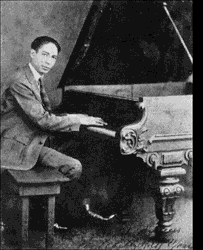
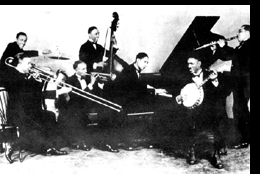
Jazz began to develop all over the U.S.A. but particularly in New Orleans. In the clubs and bars of New Orleans, musicians like Jelly Roll Morton developed a piano style known as boogie woogie. Jelly Roll Morton claimed he 'invented' jazz in 1902, and with his band, the Red Hot Peppers, he made many recordings such as the ragtime style Black Bottom Stomp.
 Click
Click
 to
Hear his piano solo Frances
to
Hear his piano solo Frances
Jelly Roll Morton Jelly Roll Morton and the Red Hot Peppers
On Mississippi riverboats, small bands played with trumpet, clarinet trombone, banjo and tuba. Jackass Blues is representative of the early jazz played in New Orleans.
1910
The year 1910 seems to be the generally accepted date for the beginnings of jazz dance bands. The common line up was: 2 or more brass instruments, 2 or more saxophones or clarinets, piano, banjo, drum, sometimes a violin
Dance music played by these bands depended on SYNCOPATION for its interest, i.e. putting accents on notes that do not come at the beginning of the bar. The musical forms used were blues, ragtime, and cakewalk, etc. Increasing popularity of dance bands came with the fox-trot, a ballroom dance characterised by a march-like ragtime, slow or quick. It existed in a variety of slightly different styles such as Horsetrot, Fishwalk, Charleston and Black Bottom. The spread of the fox-trot was due to the phonograph, or gramophone, which allowed many people to practise their dance steps at home.
Jazz was not recorded until 1916 when The Original Dixieland Jazz Band, a group of white musicians, recorded Fidgety Feet.
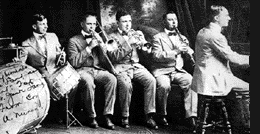
The Original Dixieland Jazz Band
The rise of popular music changed the role of music in daily life. Song lyrics came to reflect the fundamental concerns of the family, portraying hope, despair, heroism, humour, frustration and above all love.
After 1917 many jazz musicians were based in Chicago and worked in bars controlled by gangsters such as Al Capone. American Jazz swept Europe during World War I (1914-18) due to an American called James Europe, who toured Western Europe with his band and was highly acclaimed. European and U.S. performers cultivated international audiences. Dance halls gradually acquired an air of respectability and professional bands began to provide the music in the newly opened ballrooms that were established.
The 1920s
The main factor in the growth of popular music in the 1920s was the development of radio. This had been overshadowed in the first twenty years of the century by the gramophone, but technological development enables radios to be mass-produced cheaply by the end of the First World War. In the U.S.A., sales figures for radios soared to $800 million by 1930. Many dance halls employed resident bands. The undisputed 'King of Jazz' was Paul Whiteman, a classically trained musician who turned to jazz around 1914. Bix Beiderbecke was also an extremely well-known jazz trumpeter who excelled at improvisation and introduced the saxophone into his own band.
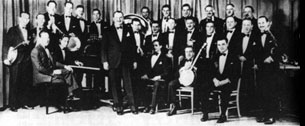
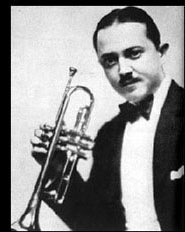
Paul Whiteman and his band Bix Beiderbecke
A characteristic piece by Bix Beiderbecke and his Gang is Jazz Me Blues.
Click to
Hear the piano solo In A Mist by Bix Beiderbecke
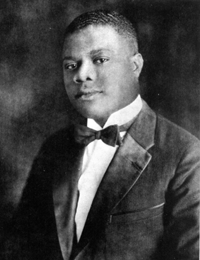
Another famous soloist was Louis Armstrong. His trumpet virtuosity can be heard on West End Blues.
 Click to
Hear Louis Armstrong's What A Wonderful World
Click to
Hear Louis Armstrong's What A Wonderful World
Louis Armstrong
Towards the end of the 1920s New York became the centre of jazz in America. Bands started introducing other instruments such as string bass, guitar and piano which obviously increased their size so they became known as Big Bands.
BIG BANDS
Big bands are exactly as their name suggests. Big bands developed in the 1920s and became especially popular in the 1930s and early 1940s. Two famous band leaders were Glenn Miller (famous for In the Mood) and Benny Goodman. Some of the 1920s big bands even included a string section. Glenn Miller's song Chattanooga Choo Choo was the world's first million selling disc.
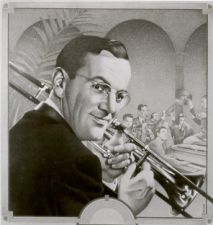
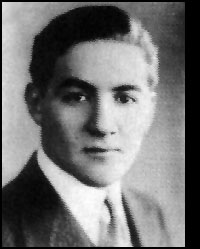
Glenn
Miller Benny
Goodman
Click to
Hear Glenn Miller's In The Mood
Teenagers supported their favourite band with the same excitement that many now apply to pop groups. To accompany the Swing music, new athletic dances were created which involved swinging partners around and much fancy footwork. These often had colourful names such as the Lindy Hop, the Jitterbug, the Big Apple and Kicking the Mule. These were very different from the slow dances like the Fox-trot which had been fashionable.
The best Swing bands were those led by Duke Ellington and Count Basie, who usually had the best players in their bands. Swingin' the Blues is representative of Swing Band music of this time.
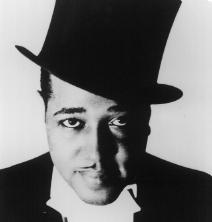
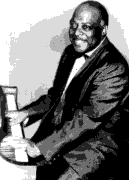
Duke Ellington Count Basie
Click to
Hear Duke Ellington's It Don't Mean A Thing.
Ella Fitzgerald was a leading vocal soloist with Big Bands. Her version of Mack the knife has become a classic.
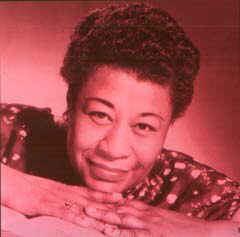
Ella Fitzgerald
The Swing band era reached its end with the end of World War Two due to the government imposing an entertainment tax of 20%, more people having TVs, and small Jazz groups were cheaper to hire than Big Bands. For the 20 or 30 years of the Swing band era, jazz became the 'pop' music of the day. If you went to a dance, put money into a jukebox, or turned on the radio, you would hear a Swing Band.
Since the 1940s more complex styles of jazz such as 'Bebop' and 'Cool' have developed which are very different from the more traditional types of jazz.
MODERN JAZZ
During the 1940s many young musicians in America were becoming dissatisfied with the predictable sounds of Swing Jazz. Performers such as Dizzie Gillespie and Charlie Parker began experimenting with new ideas and developed a style known as Bebop. This music abandoned the traditional rules of playing jazz. It was an energetic, up tempo form with jerky changes of rhythm, rapid melodies and much use of improvisation. Perhaps is representative of Bebop jazz.
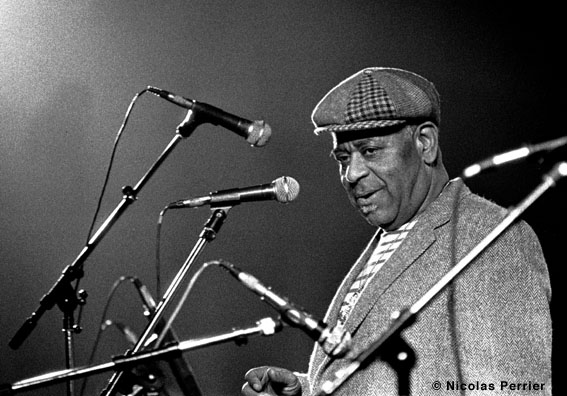
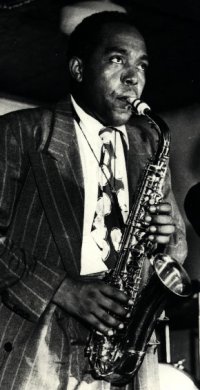
Dizzy Gillespie Charlie Parker
During the 1950s there was a reaction against the nervous excitement of Bebop and Cool Jazz was developed, which was more laid back and mellow, with easier rhythms and softer tones. Miles Davis was the most important figure in the development of Cool Jazz. He often used a mute on his trumpet to produce a quiet, muffled sound. Davis also introduced a range of instruments such as the oboe, flute, tuba and French Horn which had not been used in jazz before. Other performers such as Don Cherry and Roland Kirk introduced instruments from all over the world including Tibet, India and China, and called this form Free Jazz. Free Jazz was not a commercially successful style of music as many thought the squawks and squeals did not sound like music at all. Darius I is representative of Cool jazz.
Click  to return to GCSE resources. Click
  to move on to Rock and Pop music notes.