|
|
|
CANON A CANON is a contrapuntal piece, or section of a piece which essentially relies upon IMITATION. Imitation is the repetition of a phrase previously played by another instrument or voice. Another name for a canon is ROUND. One vocal or instrumental part leads off with a melody and then, shortly afterwards, a second part IMITATES, note for note, the same melody. The imitating part may follow at a distance of half a bar, one bar, two bars, or any other distance, according to the composer's choice. Other parts may enter successively with the same melody. Here is a Canon by Pachebel (1653-1706) for strings and organ and cello CONTINUO.
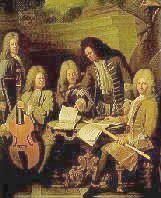
Pachelbel (in the centre) The piece also uses a device called GROUND BASS (or BASS OSTINATO). This is a bass line which is repeated over and over again. In this piece the bass line is played by an organ and 'cello continuo. Although a continuo is usually played by 'cello and harpsichord, in some Baroque music, particularly church music, an organ and 'cello or organ and bassoon can be used instead. Here is the GROUND BASS used in this piece.
GROUND BASS SOUND THE TRUMPET by Purcell (1659-95) This duet is from Purcell's Come ye sons of art, a cantata he wrote in 1694. It is written for two male altos or countertenors, accompanied only by continuo. Purcell builds up the music in his favourite form - the ground bass. When you listen to this piece try to identify the repeating pattern of notes which forms the ground bass on which the music is built.
FUGUE A FUGUE is a piece of instrumental music which is contrapuntal in texture and is based upon the idea of IMITATION. It is usually written in three or four lines called VOICES, no matter whether the Fugue is VOCAL or INSTRUMENTAL. These lines or voices are referred to as SOPRANO, ALTO, TENOR and BASS. The detailed structure of a fugue can be very complicated, but the basic idea is this - 1. The entire fugue grows mainly from a single, fairly brief tune. This is called the SUBJECT. 2. The SUBJECT is first heard in one voice only. Then it is imitated by the other voices in turn, each at its appropriate pitch. 3. Throughout the fugue, the subject enters in new keys - alternating all the time with different voice parts. 4. Sections within a fugue which do not involve the subject at all are called EPISODES. Bach, Handel and Purcell wrote many, many fugues for a variety of different instruments. Bach, in particular, wrote some of the finest fugues ever written. His most famous fugues for harpsichord called 48 Preludes and Fugues which demonstrate preludes and fugues written in every different key. These fugues are nowadays usually performed on the piano. Try to identify these features as you listen to fugue no.2 by Bach
Fugues can also be choral. A good example of this is a chorus from part II of Handel's Messiah. The subject is introduced in bars 1-5. The voices SATB all enter with the fugue subject. THE SUITE The word SUITE means a piece of music consisting of several movements. Baroque suites consist of groups of DANCE music. Many suites were written for harpsichord and included dances from different countries. These suites often contained six or seven dances. All of these dances were usually in the same key and were in BINARY FORM. Common dances from a Baroque suite are ALLEMANDE (GERMAN) 4/4 time - Moderate speed COURANTE (FRENCH) 3/2 time - Moderately fast SARABANDE (SPANISH) 3/4 time - Slow MINUET (FRENCH) 3/4 time - Moderate speed GAVOTTE (FRENCH) 4/4 time - Fairly fast BOUREE (FRENCH) 2/2 time - Fast GIGUE (FRENCH) 6/8 or 12/8 - Fast Bach wrote six 'French Suites' for harpsichord.
Click PEDAL A PEDAL is a note, often heard in the bass which is held or repeated whilst the melody continues above it. Composers from all different periods of history use this technique. Below is an example of a pedal heard in Gavotte no.2 from the English Suite no.3 by Bach.
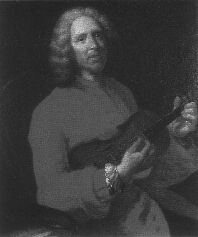
OPERA The 17th century also saw the beginnings of a new 'musical/dramatic' form. This was OPERA. A simple definition of opera is a play set to music. Operas contain - An OVERTURE - Purely orchestral music introducing an opera RECITATIVES - Singing using the natural rhythms of speech There are two types - 1)'Secco' which means 'dry', in which the voice may be supported by plain chords on a harpsichord, perhaps with a 'cello strengthening the bass-line. 2)'accompagnato' which means 'accompanied', used when the composer feels the dramatic nature of the words needs to be heightened by an orchestral accompaniment of some kind. ARIAS - A song for one voice CHORUSES - Songs often sung by a whole choir (SATB) SATB refers to Soprano, Alto, Tenor, and Bass These voice ranges are - Among composers of opera during this period are -
Monteverdi - Italy
Rameau - France Dido and Aeneas by Henry Purcell. This opera was produced about 1689 at a boarding school for girls in Chelsea. The libretto (words) are by Nahum Tate. ACT I Scene 1: The Palace at Carthage Belinda (Soprano) lady in-waiting to Dido, Queen of Carthage (Soprano), bids her mistress to shake off her cares. Belinda knows that her mistress has been moved by pity for Aeneas, a Trojan Prince, who, on a voyage, has been driven by storms to the coast of Africa and has come to Dido's court. Belinda also knows that each loves the other. Aeneas (Tenor or Baritone) enters. Dido fears some danger fated for their love, but the hero is confident. Scene 2: A Sorceress's Cave A Witch (Mezzo-soprano) bids her attendants go as messengers to Aeneas, pretending that they are sent by Jove himself. They are to tell him that Jove commands him to depart at once from Carthage. ACT II Scene: A Grove Dido and Aeneas pursue the chase. When all but Aeneas have been driven back to the court by a storm that the witch has raised, the Witch's spirit, appearing to Aeneas in the likeness of Mercury (Soprano or tenor), the messenger of love, gives the pretended message from Jove. Aeneas is to leave love's delights and sail from Troy, which he is to restore from its ruins. Aeneas, heavy-hearted, obeys, doubting how he shall pacify Dido. ACT III Scene: The Ships A Sailor (Tenor) instructs his mates how to take their leave of the damsels of Carthage - by vowing to return. The witch sings her triumph. Dido is broken-hearted at Aeneas's desertion and has caused her funeral pyre to be prepared. Though he is willing to risk Jove's displeasure by staying, she bitterly rejects his offer, regarding him as faithless and herself as slighted. He goes, and she, after singing the famous Lament (see below) stabs herself upon the pyre, which consumes her body. Dido's Lament, from Dido and Aeneas by Purcell (1659-1695) Dido and Aeneas is Purcells' only opera. Dido, Queen of Carthage, falls deeply in love with Aeneas, who has been driven to her shores during a violent storm. But Aeneas is tricked by witchcraft into deserting her. Dido, her heart broken, sings this lament as she is dying. This piece contains a very good example of a GROUND BASS.
Click ORATORIO Like operas, ORATORIOS contain - An OVERTURE, RECITATIVES, ARIAS and CHORUSES Unlike opera, however, NO ACTING is involved. Oratorios are usually based on religious themes and the text is often taken straight from the bible. The most famous composer of oratorio is Handel. He composed many oratorios; among the Israel in Egypt, Samson and the most popular of all the Messiah.
Click CANTATAS CANTATAS are like miniature oratorios. In the Baroque period they were written for soloists and chorus, accompanied by orchestra and continuo. Bach composed more than 200 church cantatas which were used as part of morning worship in the German Lutheran church. His cantatas are often based on a CHORALE and often close with the chorale which the congregation were expected to sing. A Chorale is simply a traditional hymn, often sung in four parts but generally HOMOPHONIC in texture.
Click
Click |
 Part
II
Part
II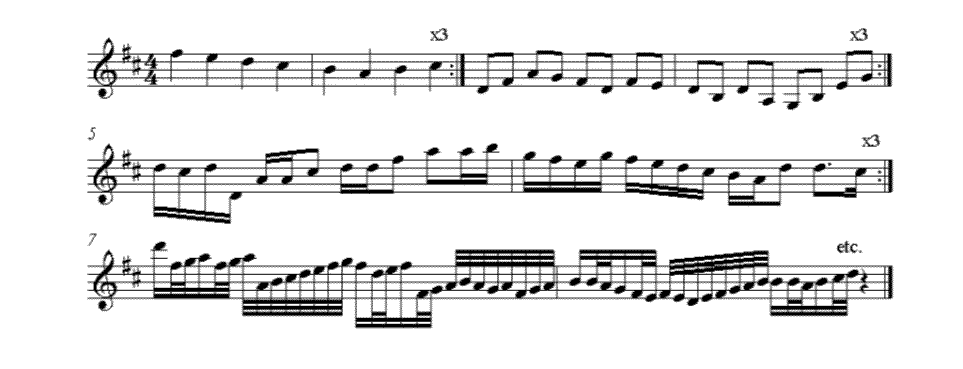
 Click
Click 

 Click
Click  Click
Click 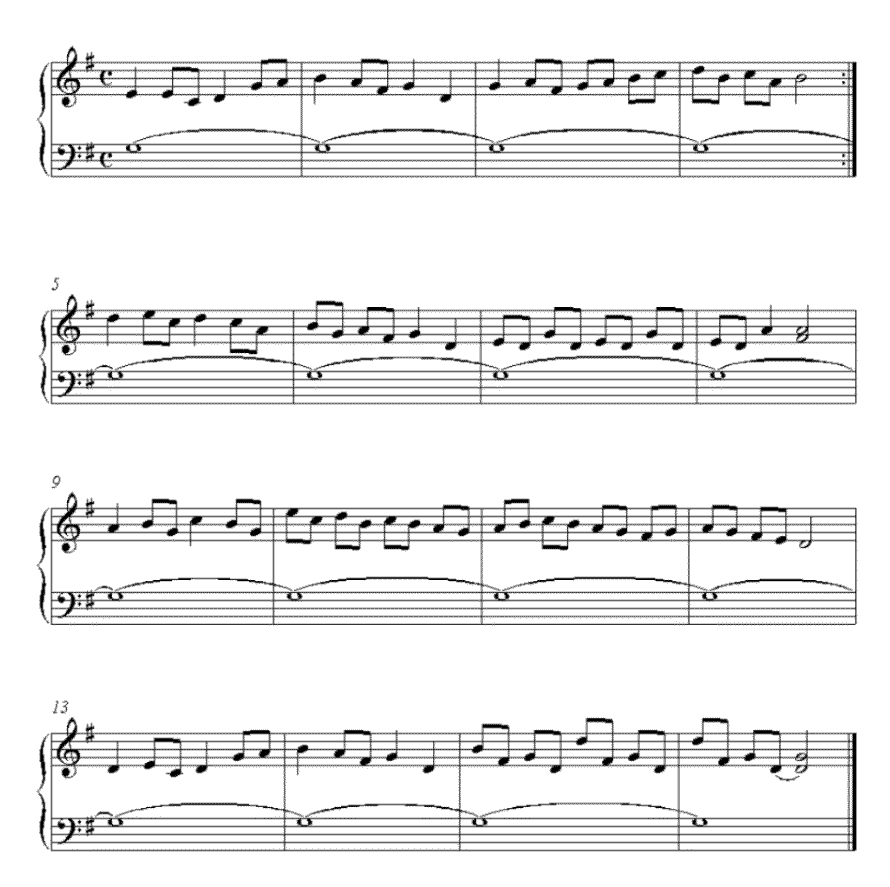
 Click
Click  Scarlatti - Italy
  Lully - France
 Handel - Germany
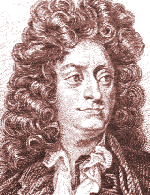
  Purcell - England